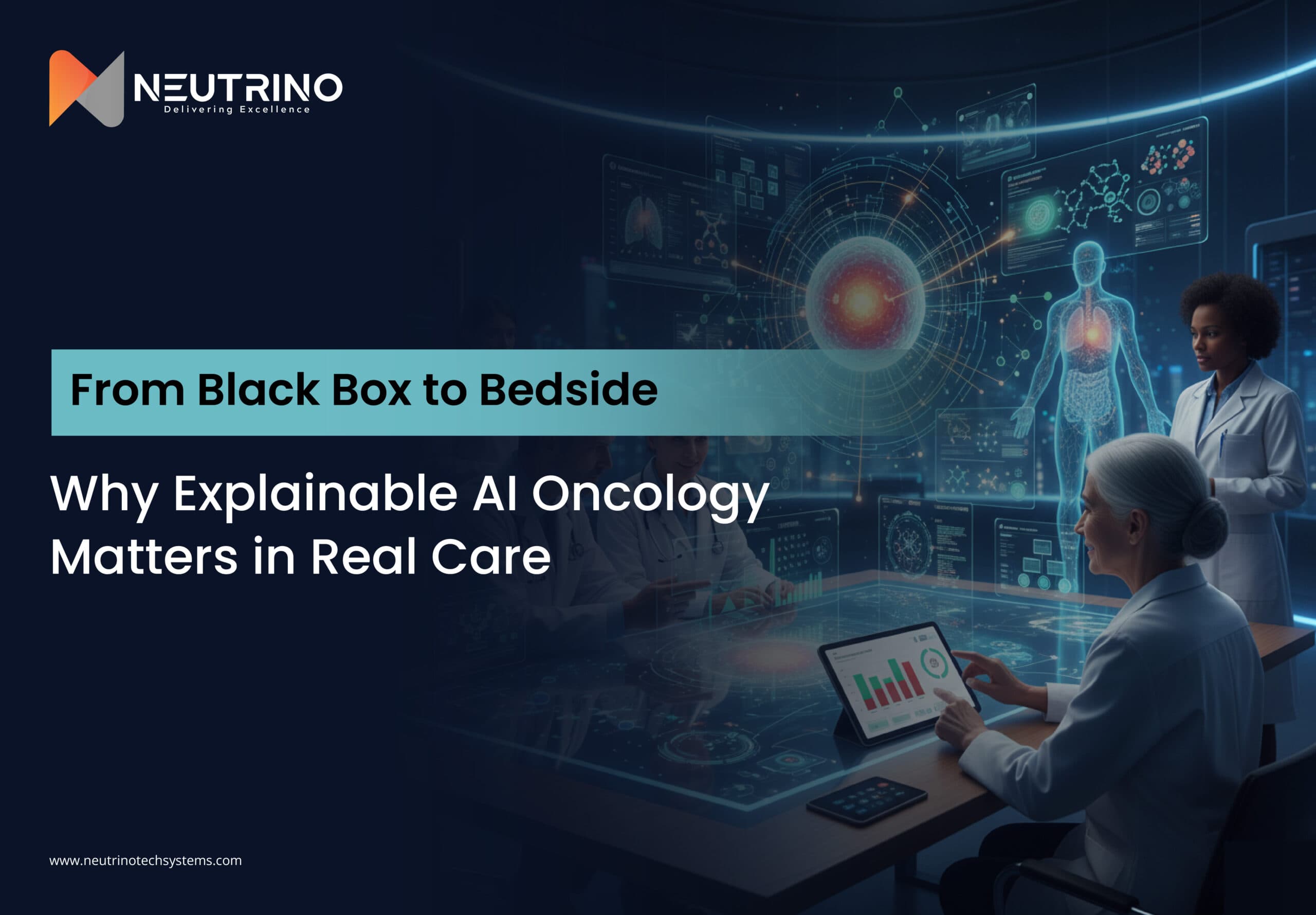
A single recommendation can change the course of a cancer patient journey. It can shape hope, uncertainty, and the decisions patients and clinicians carry forward together. Yet despite rapid advances in artificial intelligence, trust remains fragile.
Why Black-Box Systems Fail Without Explainable AI Oncology
In tumor boards, where decisions are debated, challenged, and refined, recommendations that cannot be explained often stall rather than accelerate action. Clinicians need to understand not only what an AI system predicts, but the clinical reasoning behind it.
Interpretable Models Clinicians Can Reason With
In explainable AI oncology, interpretability becomes most effective when model signals align with familiar clinical variables. Feature attribution tied to biomarkers, disease staging, imaging patterns supports informed decision-making.
Platform-Level Explainability
Explainability cannot be treated as a surface-level feature added after models are deployed. In high-stakes domains like oncology, trust is shaped by how consistently transparency is maintained across the entire system.
Trust extends beyond clinicians. Patient understanding and communication play a decisive role in acceptance, especially when AI influences care decisions. Platforms that scale responsibly embed explainability into architecture.
Closing Thoughts on Explainable AI Oncology
This is the approach taken by Neutrino Tech Systems, where AI and innovation are applied with deep healthcare context. By focusing on explainable, human-centered systems, Neutrino works to ensure intelligence earns confidence at every step of the oncology journey.