In today's patient access ecosystem, speed to therapy is no longer just an operational KPI — it directly impacts patient outcomes, therapy adherence, provider satisfaction, and manufacturer performance. Yet despite billions invested in digital transformation across healthcare, one of the biggest barriers to efficient patient access remains unresolved: interoperability.
The modern patient journey spans a highly fragmented ecosystem involving hubs, specialty pharmacies, providers, EHRs, ePA vendors, payers, copay vendors, laboratories, and manufacturer support programs. Each stakeholder operates on different systems, workflows, data standards, and communication channels. The result is a disconnected operational environment where critical patient information is constantly moving — but rarely in a seamless or standardized way.
This fragmentation creates significant delays and operational inefficiencies across patient services and market access workflows.
The Real Problem: Healthcare Workflows Are Still Operating in Silos
Most patient support programs today rely on a patchwork of technologies and manual processes. Referral forms arrive through fax, portals, email attachments, and EHR integrations. Benefits verification teams manually validate payer information across multiple systems. Prior authorization teams navigate payer-specific requirements that constantly change. Specialty pharmacies maintain separate dispensing and fulfillment systems. Providers often lack real-time visibility into case status, missing documentation, or affordability outcomes.
Even when integrations exist, they are often point-to-point, brittle, and workflow-specific rather than designed as part of a connected operational fabric.
This creates several operational challenges: duplicate data entry across systems; inconsistent patient records and missing information; delays in benefits verification and prior authorization; lack of visibility into downstream therapy progression; manual reconciliation between hub, pharmacy, and provider systems; inability to proactively identify access barriers; and limited operational intelligence across the patient journey.
In many organizations, teams spend more time gathering information than actually resolving patient access issues.
Why Traditional Integration Approaches Are Failing
Historically, healthcare organizations attempted to solve interoperability through direct integrations or middleware orchestration. While these approaches help exchange data, they rarely solve workflow fragmentation.
The core issue is not just moving data from System A to System B. The real challenge is creating contextual continuity across the patient journey.
A referral may originate from an EHR. Coverage determination may occur in a hub CRM. Prior authorization may happen through an ePA platform. Dispensing updates may come from a specialty pharmacy. Affordability support may exist in another workflow. Adherence outreach may happen through a separate engagement platform. Each system contains only a partial view of the patient journey.
Without a unified operational layer, organizations struggle to create a complete, longitudinal understanding of patient access progression.
The Need for a Connected Patient Access Ecosystem
The future of patient access requires more than integrations — it requires interoperability with orchestration.
Organizations need platforms that can normalize data across disparate systems; maintain contextual continuity across workflows; orchestrate operational processes across stakeholders; enable configurable workflows for different therapies and programs; surface actionable operational insights in real time; support both structured and unstructured healthcare data; and adapt to evolving payer and access requirements.
This is where a modern interoperability-first approach becomes critical.
How We Are Solving This Through AccessHub™
At Neutrino, we designed AccessHub™ to address interoperability challenges not as an afterthought, but as a foundational principle of the platform.
AccessHub is built as a connected Patient Services and Market Access ecosystem that unifies workflows across intake, enrollment, benefits verification, affordability, adherence, specialty pharmacy coordination, field support, and outcomes management.
Instead of treating integrations as isolated projects, the platform creates a unified operational framework where patient access workflows can function cohesively across systems and stakeholders.
Unified Workflow Orchestration
AccessHub centralizes operational workflows while allowing organizations to continue using their existing CRM, specialty pharmacy, payer, and provider systems.
This enables shared operational visibility; cross-functional case management; workflow continuity across departments; standardized operational governance; and program-specific workflow configuration.
The goal is not to replace existing enterprise systems, but to connect and orchestrate them more intelligently.
Longitudinal Patient Access Visibility
One of the biggest gaps in traditional patient support operations is the absence of a connected patient journey.
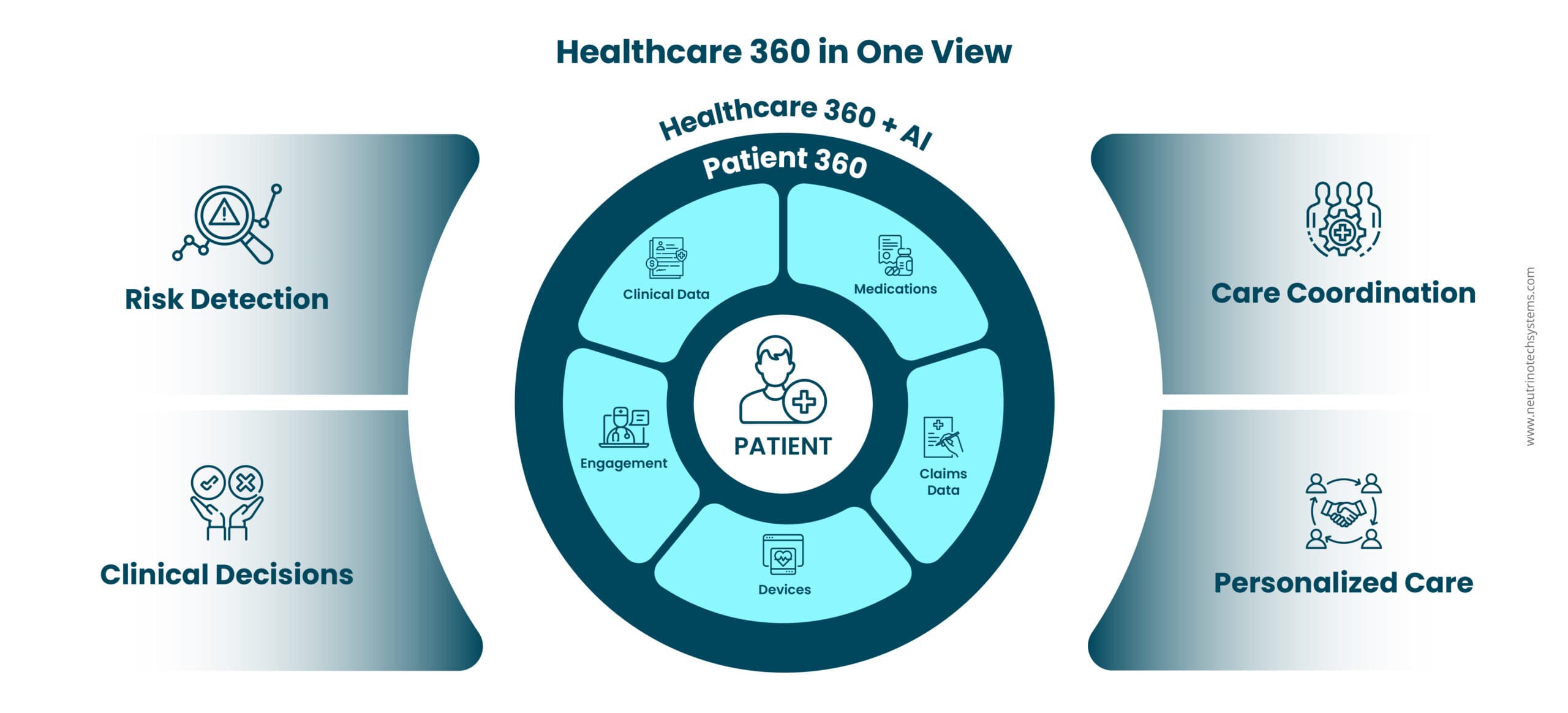
AccessHub creates a unified operational view across intake and enrollment status; coverage and reimbursement progression; prior authorization workflows; affordability program participation; specialty pharmacy fulfillment; adherence and engagement activities; and outcomes and therapy progression.
This allows teams to proactively identify bottlenecks, missing information, therapy delays, or escalation risks earlier in the process.
Configurable and Program-Aware Operations
Every therapy area, manufacturer program, and payer workflow operates differently.
AccessHub is designed with configurable workflow orchestration that allows organizations to tailor intake processes; routing logic; documentation requirements; escalation paths; approval workflows; and program-specific business rules.
This flexibility is essential in patient access environments where operational variability is the norm.
Operational Intelligence Built into Workflows
Traditional interoperability often focuses only on data exchange. Our approach focuses on operational enablement.
By connecting workflows across systems, AccessHub enables organizations to reduce manual coordination; improve speed to therapy; increase case processing efficiency; enhance provider and patient visibility; identify operational bottlenecks earlier; and improve program scalability.
The platform transforms disconnected operational activities into a coordinated access ecosystem.
The Industry Is Moving Toward Ecosystem Thinking
Healthcare organizations are beginning to realize that patient access cannot be optimized through isolated tools and fragmented workflows.
The future lies in connected ecosystems where interoperability supports workflow orchestration; real-time operational visibility; cross-functional collaboration; longitudinal patient intelligence; and faster and more predictable therapy access.
Organizations that continue relying on disconnected operational models will struggle to scale patient support programs efficiently as therapy complexity, payer variability, and patient expectations continue to increase.
Interoperability is no longer just a technical challenge — it is a business and patient outcome imperative.
And solving it requires rethinking patient access as an orchestrated ecosystem rather than a collection of disconnected systems.